Managing odour emissions in an urban environment is a complex challenge that requires the integration of measured data, meteorological information, plant-specific knowledge, and advanced modelling tools capable of accurately describing odour dispersion within urban canyons, streets, and residential areas.
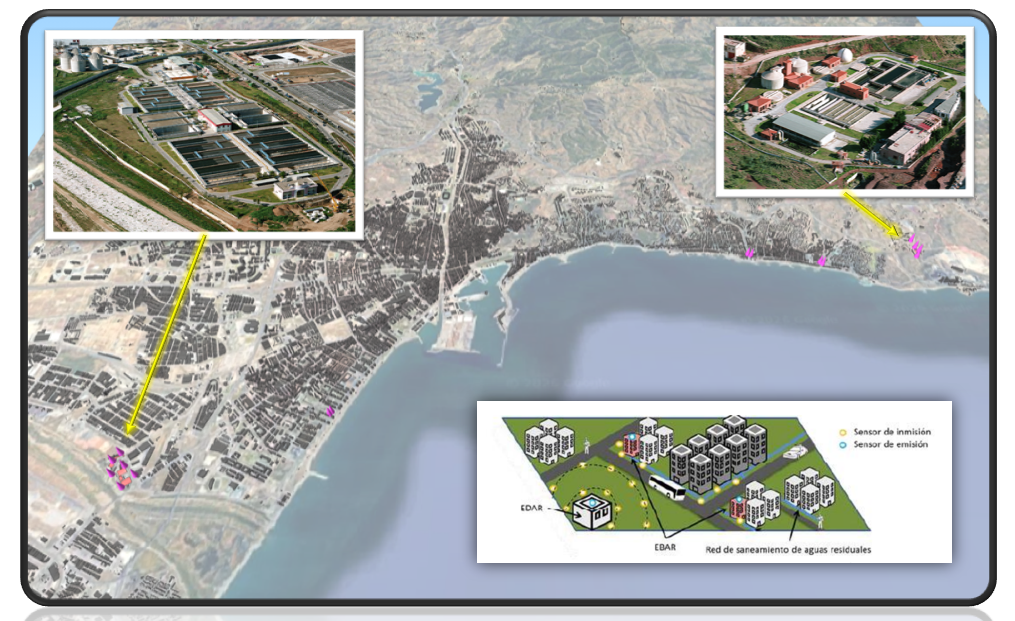
Within this context, ARIANET developed a project for EMASA – Empresa Municipal Aguas de Málaga, the municipal water utility of Málaga, Andalusia. The project focuses on monitoring and forecasting airborne concentrations of hydrogen sulphide (H₂S) associated with the city’s wastewater treatment facilities. The modelling framework covers two EDAR (Estación Depuradora de Aguas Residuales), the main wastewater treatment plants, and three EBAR (Estación de Bombeo de Aguas Residuales), pumping stations distributed across the urban area.
The objective is to provide an operational forecasting tool capable of dynamically recalibrating emission flux estimates based on real-time sensor data, while producing reliable concentration forecasts for the following day.
To achieve this, the project combines two innovative techniques:
First, the convolution of microscale dispersion kernels: Rather than executing full Lagrangian particles dispersion simulations daily, thousands of representative precomputed simulations covering a range of atmospheric conditions (wind direction, wind speed, atmospheric stability) are stored. These kernels characterize each emission source’s contribution to ground-level concentrations, which are then combined according to actual meteorological forcing and emission data.
This strategy preserves the high physical fidelity of microscale modelling and enables computation times compatible with daily operational use. In Málaga, the model generates concentration maps at a 5-metre horizontal resolution over extensive urban domains, explicitly accounting for building-induced effects on wind flow and pollutant dispersion.
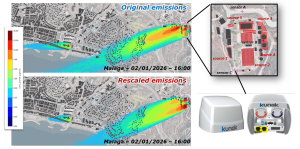 Second, an inverse modelling module, developed to robustly estimate emission fluxes by assimilating observed data from H₂S sensors deployed around the facilities. This module employs ridge-regularized regression, incorporating physical constraints to avoid non-physical emission estimates.
In practice, the system iteratively adjusts emission fluxes from various sources to minimize discrepancies between simulated and observed concentrations. Each day, the model assimilates the previous day’s observations, updates the emission flux estimates, and forecasts H₂S concentrations for the next day. This continuous self-calibration enables progressive learning from measured data.
The project exemplifies the successful collaboration between ARIANET’s Italian team and the Spanish division of SUEZ Air&Climate, which is integrating the model into the AirAdvanced platform. This integration provides the client with interactive concentration maps, real-time sensor data analysis, alert triggering, and on-demand simulation capabilities.
Consequently, the solution transcends a simple monitoring system to become a comprehensive decision-support tool. It enables emission scenario assessment, evaluation of different operational conditions, and improved management of odour nuisance episodes through informed, data-driven interventions.
Málaga’s case highlights the synergy between atmospheric modelling, environmental sensor networks, and digital platforms, a demonstration of how scientific innovation can be transformed into a daily operational service supporting urban air quality management and the efficient operation of wastewater treatment facilities.