Nature-Based Solutions and Urban Air Quality: Modelling the Effects of Vegetation on Traffic Emissions
Nature-Based Solutions (NBS), such as street tree planting or urban greening interventions, are frequently proposed as tools to improve air quality in cities.
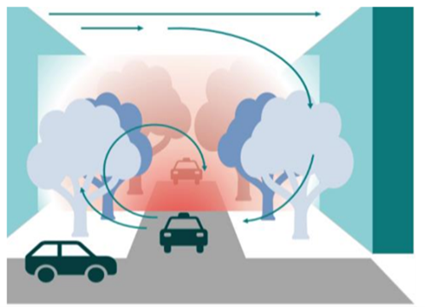
Their effect, however, is not always straightforward: vegetation can reduce pollutant concentrations by removing them from the atmosphere, but it can also alter local ventilation, sometimes producing the opposite effect.
To quantitatively assess these interventions, ARIANET has developed an operational modelling methodology that explicitly distinguishes two main physical mechanisms: the aerodynamic effect and dry deposition.
Aerodynamic Effect
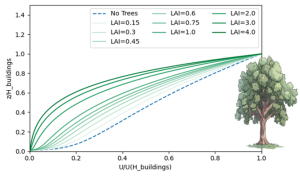
The presence of trees introduces aerodynamic drag and modifies wind and turbulence profiles in the first metres above the ground. On average, this leads to a reduction in wind speed and therefore to lower ventilation, increasing the residence time of pollutants near road sources.
The intensity of the effect depends primarily on a few key parameters related to urban configuration and vegetation.
The most important parameter is the Leaf Area Index (LAI), which represents the leaf surface area available per unit of ground surface. High LAI values indicate greater vegetative surface area and therefore greater resistance to airflow.
Other relevant parameters include:
tree height, which determines the portion of the urban boundary layer influenced by vegetation;
tree cover density, which controls the intensity of the drag exerted on the flow;
street canyon geometry, particularly the ratio between building height and street width;
wind direction relative to the street axis, which modulates the interaction between atmospheric flow and urban morphology.
The model distinguishes two main contexts.
In the case of street canyons with buildings, trees modify the interaction between the flow and the urban geometry, compressing the wind profile at lower levels and further reducing air exchange. The effect can be particularly pronounced in deep canyons, characterised by tall buildings and relatively narrow streets.
In the case of vegetation without surrounding buildings, the tree canopy is represented as a sparse canopy that introduces a drag force and modifies the turbulent mixing length as a function of LAI.
In general, the aerodynamic effect tends to produce local increases in concentrations, particularly in the immediate vicinity of road sources.
Deposition Effect
Leaf surfaces provide an effective substrate for the dry deposition of pollutants — a process through which a portion of the pollutant mass is removed from the atmosphere and transferred onto surfaces.
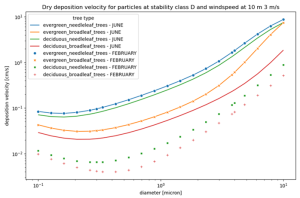
The efficiency of the process is described by the deposition velocity, which depends on several physical and biological factors.
The most important include:
 Leaf Area Index (LAI), which determines the leaf area available for pollutant interception;
vegetation type, which influences canopy structure and leaf surface properties;
tree height and density, which modify surface roughness and flow dynamics within the canopy;
meteorological conditions, such as wind speed and atmospheric stability;
pollutant type, with different behaviour between gases and particulate matter.
In the case of particulate matter, deposition velocity is strongly dependent on particle diameter, which governs the mechanisms of interception and impaction on leaf surfaces.
In the case of gases, stomatal resistance plays a central role — that is, the capacity of molecules to enter leaf stomata. This introduces a dependence on the diurnal cycle of solar radiation, since stomata tend to close at night.
Unlike the aerodynamic effect, which acts primarily close to road sources, the deposition effect tends to produce a more spatially diffuse reduction in concentrations, which may extend to greater distances from the emission source.
From Simulation to Urban Planning
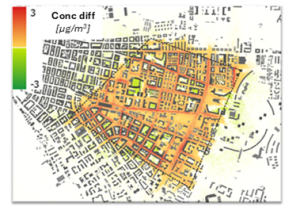
To quantify these effects, a database of numerical simulations was built using the PMSS Lagrangian particle model, allowing synthetic relationships to be derived between deposition, urban characteristics, meteorological conditions, and distance from the road source.
Nature-Based Solutions are represented as georeferenced polygons (for example, imported in a GIS software), associated with parameters such as tree height, vegetation density, and leaf type.
The system automatically combines the aerodynamic effect and the deposition effect, producing maps of ground-level concentration changes associated with the introduction of NBS interventions.
The methodology has been applied to the city of Taranto within the CALLIOPE project, with the aim of supporting the quantitative assessment of urban greening strategies in air quality planning.
In general, the overall impact of NBS on urban air quality results from the balance between the two mechanisms described: the aerodynamic effect tends to have a greater influence on concentrations in the immediate vicinity of road sources, while deposition produces a more diffuse reduction in the pollutant load. Quantitatively assessing this balance is therefore essential for designing urban greening interventions that are genuinely effective.
It is nevertheless important to stress that effects on pollutant dispersion represent only part of the overall impacts of Nature-Based Solutions. Urban greening interventions can also contribute significantly to the mitigation of urban heat islands, the regulation of urban microclimate, and the absorption of climate-altering gases. For this reason, the assessment of NBS should be embedded within integrated urban analysis frameworks capable of jointly considering effects on air quality, urban climate, and the overall environmental wellbeing of the city.